
Most organizations believe strong cyber defense equals strong security.
They invest in next-generation firewalls, EDR platforms, IAM controls, SIEM dashboards, zero-day monitoring, and layered perimeter security. Attack surfaces are reduced. Alerts are monitored around the clock. Threat intelligence services are integrated into security operations.
Even with these controls in place, production systems go offline. Supply chains stall. Treasury settlements are delayed. Dealership management platforms shut down, halting vehicle sales across entire regions.
Security maturity is measured by operational performance after containment. That is where cyber resilience becomes visible.
The distinction between cyber defense and cyber resilience determines whether an incident remains contained or escalates into a full-scale business crisis.
The Difference Between Cyber Defense & Cyber Resilience
Cyber Defense
Cyber defense focuses on preventing unauthorized access and reducing breach likelihood. It includes:
- Threat detection and prevention tools
- Network and endpoint security
- Vulnerability management
- Identity and access governance
- Continuous monitoring and alerting
These controls reduce exposure. They narrow entry points. They strengthen perimeter and internal safeguards.
Defense metrics typically measure:
- Mean time to detect (MTTD)
- Patch latency
- Access control violations
- Threat detection rates
- Security event volume
These metrics are important. They describe defensive posture strength.
They do not measure how fast revenue systems come back online after ransomware encrypts production servers.
Cyber Resilience
Cyber resilience measures operational survival under breach conditions.
It focuses on:
- Containment time
- Recovery time objective (RTO)
- Recovery point objective (RPO)
- Backup immutability
- Business continuity execution
- Incident response coordination
Resilience metrics answer operational questions:
- How long were systems unavailable?
- Was backup data clean and uncompromised?
- Did production resume within defined SLA windows?
- Were customer commitments met?
- Did communication reduce reputational damage?
Resilience is validated during a crisis, instead of during the audit.
Case Studies
Clorox: The manufacturing and order processing systems were disrupted due to a cyberattack. This breach led to a massive financial hit of over $350M along with product shortages and operational delays.
Impact: Operational continuity gets disturbed when the core systems go offline.
ICBC Financial Services: The U.S Treasury Trade settlements were heavily impacted due to the attack in 2023. The systems were turned off and the bank was forced to do manual trade processing, which affected major financial market operations.
Impact: When infrastructure players lack operational resilience, systemic risk surfaces.
CDK Global: A cyberattack in 2023 shut down entire dealership management systems across North America. Thousands of car dealerships were unable to process sales, financing, and other services.
Impact: An ecosystem-wide disruption when a centralized platform is attacked.
All these incidents have one thing in common. They prioritized defense over resilience. Their workflows and processes were hampered leading to major disruptions in their efficiency.
Why the Difference Matters for Modern Organizations
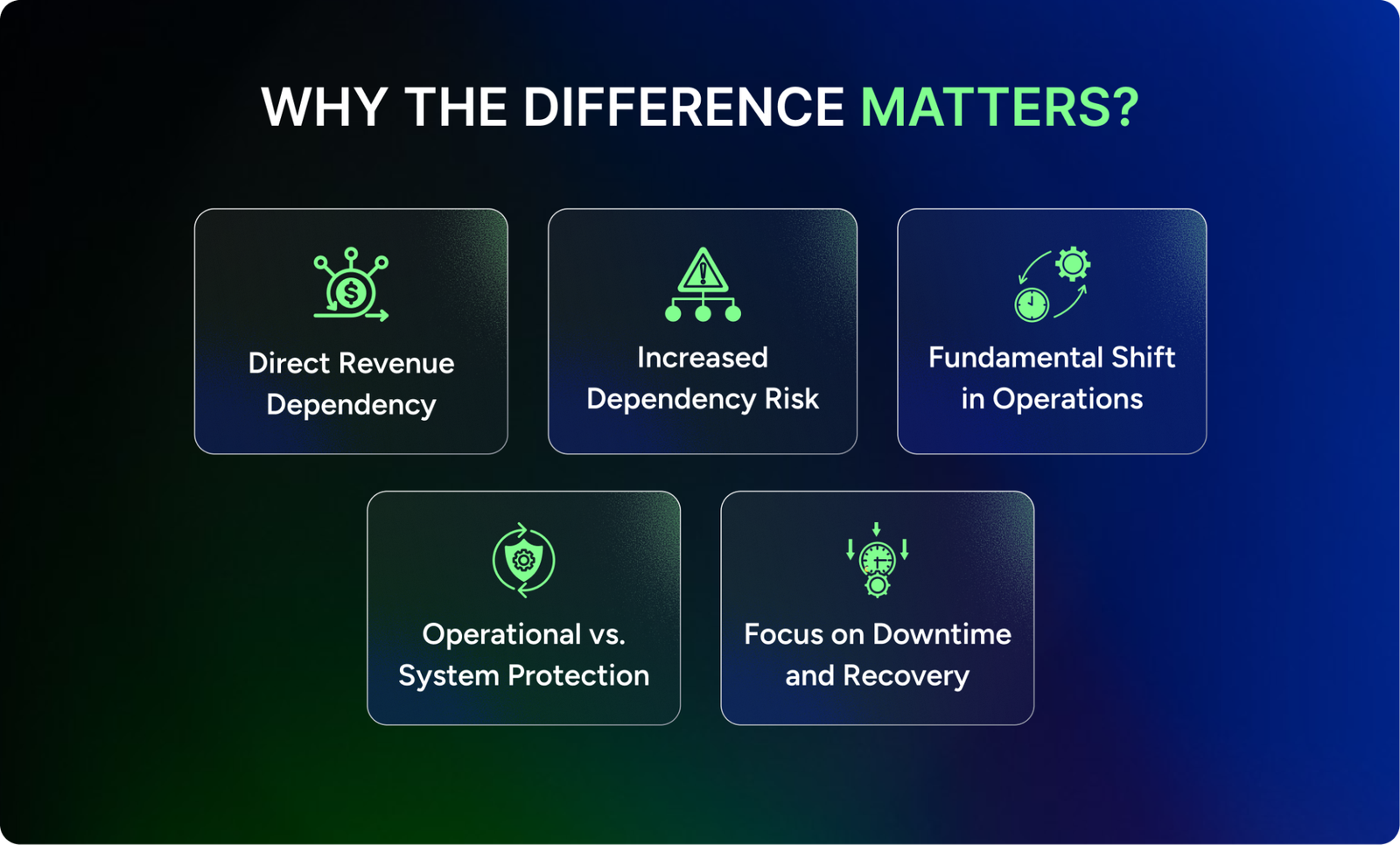
In most enterprises today, revenue depends directly on digital systems.
Order management runs through ERP. Payments flow through integrated gateways. Manufacturing depends on connected production systems. Treasury runs through settlement platforms. Customer support relies on SaaS ticketing tools.
When those systems stop, revenue stops.
Ten years ago, cybersecurity strategy focused on building strong perimeters. Data centers were centralized. Network boundaries were clear. Most infrastructure was owned and managed internally.
That model no longer reflects how businesses operate.
Today, a single customer transaction might depend on:
- A cloud-hosted application
- A third-party identity provider
- An API to a payment processor
- A logistics integration
- A SaaS CRM
- A vendor-managed analytics platform
Each one of those systems introduces dependency risk.
If one fails during a cyber incident, it can halt the entire business workflow.
This is where the difference between defense and resilience becomes operationally critical.
Defense focuses on preventing unauthorized access. It strengthens authentication, monitors logs, blocks malicious traffic, and reduces vulnerabilities. These are necessary controls.
Resilience focuses on business continuity under breach conditions. It answers:
- How long can the ERP system be offline before financial reporting is impacted?
- How fast can identity systems be restored if compromised?
- Are backups segmented so ransomware cannot encrypt them?
- Has the recovery process been tested with real restoration drills?
- Can core services be isolated without shutting down the entire network?
In distributed architectures, breaches do not stay contained in one place. Lateral movement across integrated systems is common. Vendor access increases complexity. Cloud misconfigurations introduce exposure.
A defensive program may detect the intrusion. A resilient program ensures the company continues operating while the intrusion is being handled.
From an operational standpoint, this difference affects:
- Revenue continuity
- Regulatory reporting obligations
- Contractual SLA compliance
- Supply chain stability
- Market confidence
Board-level discussions increasingly focus on downtime tolerance and recovery readiness, not just firewall strength.
Security leaders are now measured on:
- Mean time to contain
- Mean time to recover
- Backup validation frequency
- Incident simulation maturity
- Cross-functional coordination effectiveness
In a connected enterprise, the cost of downtime often exceeds the cost of the breach itself. That is why the distinction matters.
Defense protects systems from intrusion. Resilience protects the business from operational collapse.
Cyber Defense without Cyber Resilience
The gap between defense and resilience appears at the governance level, not at the technical level. Security teams may operate efficiently, alerts are triaged, vulnerabilities are patched, access is controlled.
The critical question is ownership of business continuity during a cyber event that disrupts core operations.
In many organizations, that ownership is unclear.
When a breach escalates:
- IT moves to containment.
- Security begins forensic analysis.
- Legal evaluates disclosure obligations.
- Business units wait for system access updates.
- Leadership requests impact assessments that are still being compiled.
Decision-making slows, authority lines become unclear, recovery priorities shift without structured sequencing.
This reflects a governance design gap.
Defense programs are usually centralized within security teams. Resilience requires predefined accountability across IT, operations, finance, legal, communications, and executive leadership.
Without established authority models, crisis governance becomes inconsistent. Delays increase financial exposure, regulatory risk, and reputational damage.
Organizations with mature resilience frameworks define these decisions in advance:
- Who has authority to shut down systems?
- Who approves external communication timelines?
- Which business functions receive restoration priority?
- How is financial impact estimated within the first 24 hours?
- How frequently is crisis leadership rehearsed?
These governance decisions determine operational stability during disruption.
When Defense Meets Resilience
Alignment occurs when cyber risk is embedded into enterprise risk management structures.
In mature organizations:
- Cyber events are integrated into enterprise risk reporting.
- Downtime thresholds are tied to financial impact models.
- Crisis leadership roles are documented and rehearsed.
- Board reporting includes recovery readiness indicators.
- Resilience investments are justified through continuity and capital protection analysis.
Security becomes a structured business stability function within the organization. This integration influences budget allocation, executive oversight, and leadership preparedness.
Bottomline
The benchmark for cybersecurity maturity is shifting. Boards that once asked “are we protected?” are now asking “how fast can we recover, and who is accountable when we can’t?”
Those are resilience questions. And most organizations don’t have the answers documented, rehearsed, or stress-tested.
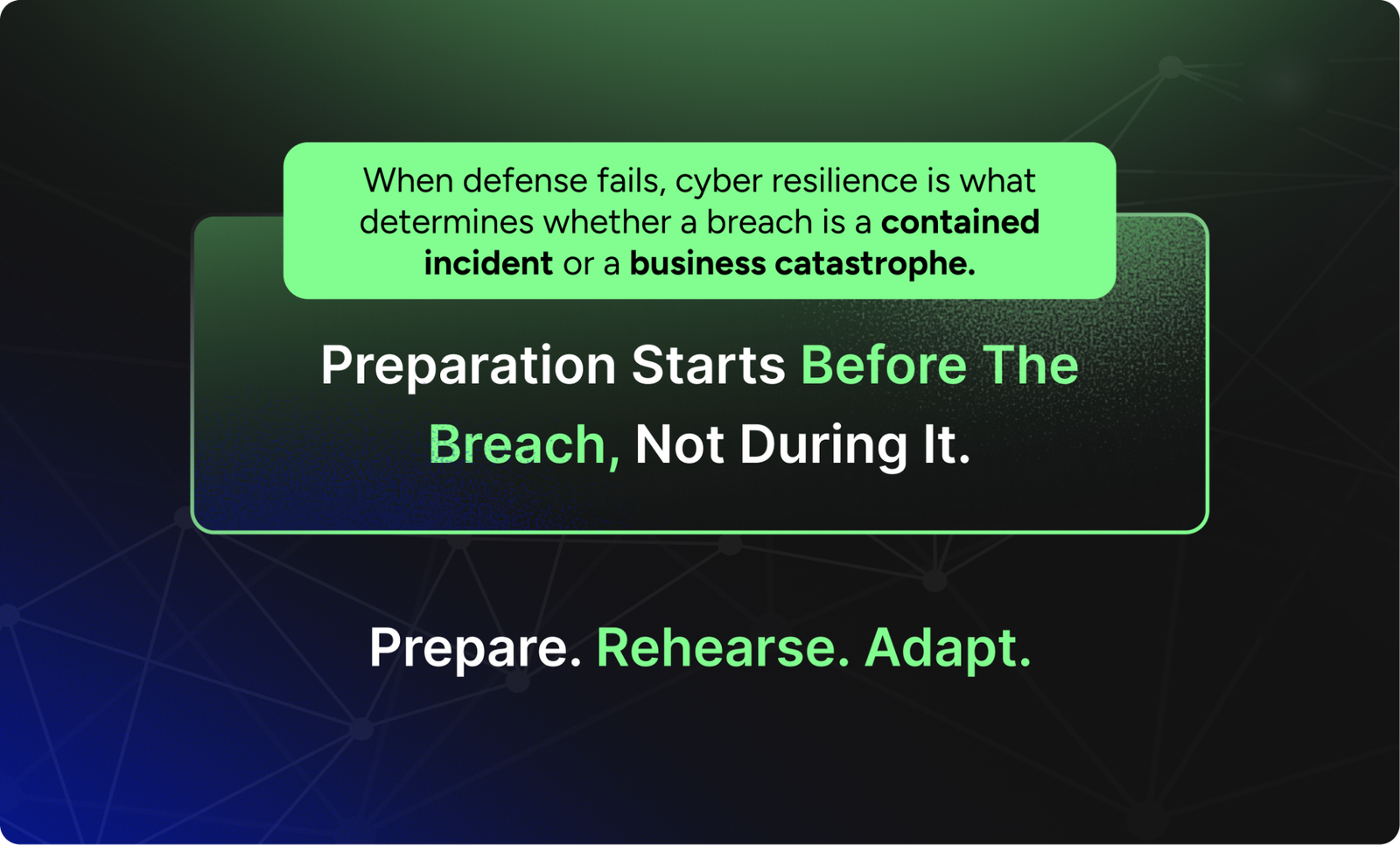
Defense reduces the likelihood of a breach. Resilience determines whether a breach becomes a contained incident or a business crisis that makes the news. The organizations that manage cyber events without lasting operational damage aren’t necessarily better defended. They’re better prepared for the moment defense fails.
That preparation starts before the breach, not during it.