Growth is a sign of success. I am sure everyone thinks like that. And it sure is.
However, growth is also a sign of more responsibility, towards the consumer and their data. As enterprises move forward, they often forget to account for shifts in data security needs. Until something breaks. Then they rush to fix it, only to find that the damage is almost irreversible. Why did this happen?
Growth Creates Complexity: Complexity Creates Blind Spots
When organizations are new, data security is simple. Limited users, fewer systems, and clear visibility into how everything collaborates. The teams know where their data resides, who can access it, and how it moves.
However, as organizations grow, clarity starts fading. New tools are integrated, new teams are onboarded, third-party vendors become an integral part, and suddenly, your security becomes scattered.
Each of these decisions was too important to ignore, but collectively they all created multiple gaps and blind spots in your data security posture.
These blind spots do not show up on your dashboards. They only appear when you are finding them after an incident.
Tool Sprawl: More Does Not Always Mean Better
As risks start piling up, the natural response is to invest in more data security tools. Enterprises integrate cybersecurity solutions like endpoint protection, network monitoring, cloud security, and identity management. Every layer promises something extra, and it works well initially.
But with time, tool sprawl introduces new data risks. Teams start monitoring tools instead of risk. They are involved in multiple dashboards, various alerting systems, and independent data streams.
Instead of a unified security solution, organizations are left with fragmented visibility. It feels like everything is being monitored, but in reality, each tool shows a single picture when what you need is an overall assessment of your security posture.
Let’s have a look at some real-life incidents at some of the biggest enterprises.
SolarWinds
The SolarWinds attack is one of the best examples of a data security compromise. The attackers managed to infiltrate their development process, which was just one module of many, and insert malicious code in their updates. Approximately 18,000 organizations and businesses installed the update, including various government agencies. Now the attackers had access to all these businesses.
A classic incident of third-party vulnerability.
MOVEit
In June 2023, a critical vulnerability in MOVEit managed file transfer (MFT) software led to a large-scale data breach. Attackers found a hidden weakness in the software, which allowed them to break in and steal sensitive data. The attack exposed sensitive information from thousands of organizations and nearly 100 million individuals.
An attack embedded in software starts a chain.
Kaseya VSA Attack
REvil, a notorious ransomware group, attacked a software provider, Kaseya. The attack targeted a software vulnerability (CVE-2021-30116) in a remote computer management tool. The hacker group boasted that millions of devices were infected, and they would provide a universal decryption key for $70 Million in bitcoin. The fallout lasted weeks, leading to huge reputational & capital damage.
A small loophole costs a fortune.
All of the above scenarios reflect common problems. Scattered infrastructure, complex security, and invisible risk.
Decisions That Create Future Data Security Risks
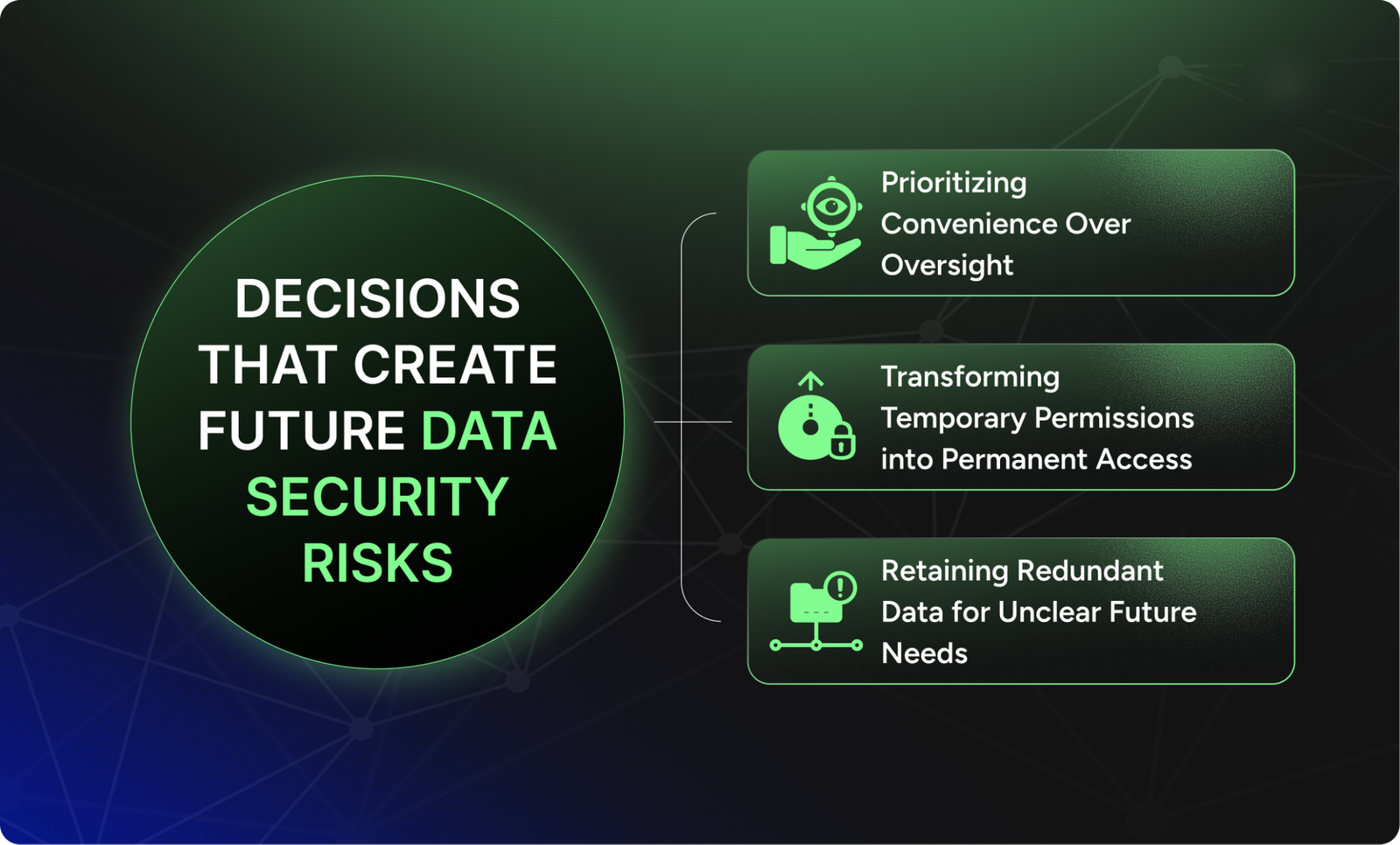
In an enterprise, security gaps do not emerge overnight. They are a result of small decisions that were made with good intentions but without proper oversight.
A SaaS tool makes meetings easy. Access is spread to avoid delays and connect seamlessly. But on the backend, data is being duplicated across multiple systems, and by the time you know it, temporary permissions become permanent.
The problem here is not integration, it’s supervision. With time, the risks pile up, while access keeps expanding. Data moves across multiple environments, and the system begins to lose governance.
Organizations rarely pause to ask:
- Does this access still need to exist? “Because who has time to figure this out?”
- Is this data still required here? “What’s the worst that could happen?”
- Is this data still secure? “Maybe we need it in the future. Let it be.”
These checks feel like a hassle, and most enterprises assume it’s non-productive. However, when an attacker targets organizations, these vulnerabilities welcome them with a garland.
The Gap Between Security Strategy and Execution
Every organization understands the importance of data & enterprise security. No organization would think of overlooking security completely. But not everyone wants to take the pain of diving deep into the details.
On paper, everything feels secure, structured, and controlled, but execution tells a different story. Security strategies are designed for a consistent environment, but in real life, operations adapt to the needs of the hour.
Teams move at different speeds, business priorities overtake security checks, and exceptions that should have been allowed with supervision become a routine. Security becomes something defined but not consistently practiced.
This creates a security gap between intent and reality.
Organizations rely on policies for data security, but in reality, these policies are not always enforced. This makes even compliant organizations vulnerable. Compliance is just the baseline, but security needs continuous execution.
The Compounding Effect of Small Security Gaps
Data security incidents are always treated as isolated failures, but in reality, they result from multiple security gaps that accumulated while integrations were rushed.
Overlooked permissions, outdated integration, misconfigured systems, and unmonitored data flow are all minor errors, but they compound over time. When a breach happens, it is not only a system setback, it is a failure of governance, visibility, and internal risk management. Attacks are built for maximum damage across divisions.
This reflects the compounding effect of small security gaps when they are left unaddressed for long periods.
What Scalable Security Actually Looks Like?
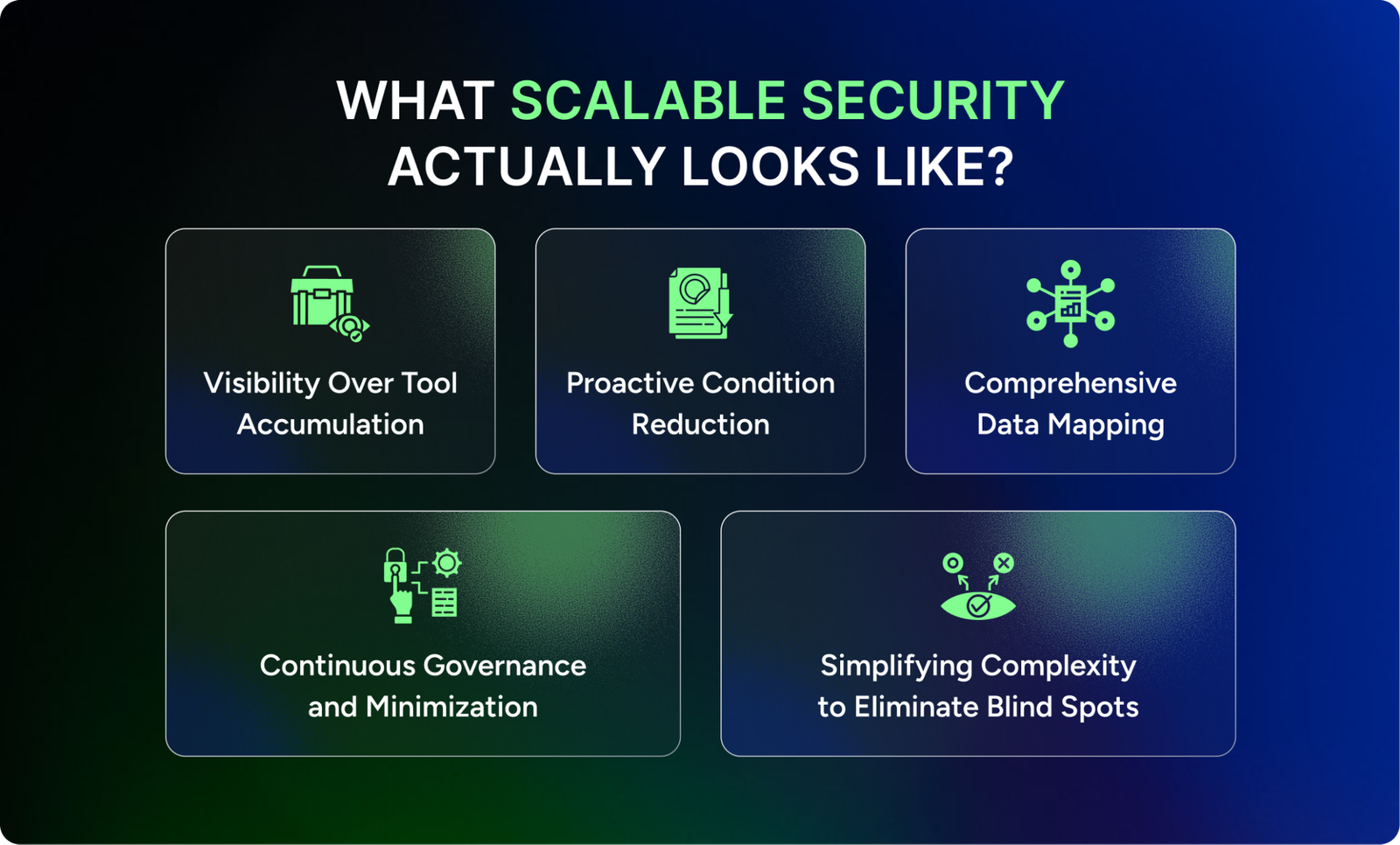
Scalable security is not just about adding multiple tools that create the illusion of security. It is more about visibility, clarity, and access without making processes vulnerable.
Expansion leads to complexity, and complexity creates blind spots, which means that security today requires a different approach.
Organizations must know these things:
- Where sensitive data exists?
- Who has access to it?
- How does it move across systems?
Hackers do not attack just to create a nuisance, they attack because they want your data. The data can be further used for more exploitation.
Which is why data needs continuous governance. Access must be reviewed regularly, data must be minimized, and integrations must be evaluated regularly.
The exploits have evolved significantly, which means security must shift from reactive to proactive. It should not exist to respond to threats but to reduce the conditions that allow threat infiltration.
The Practical Opinion
Every organization wants growth, and that is the primary reason for businesses to exist.
When organizations expand, complexity is inevitable, but blind spots are not. Fixing blind spots is not an easy task, but if organizations are vigilant about data security posture with every integration, they can close most of the gaps.
Entities that recognize this early can do more than just scale. They can build systems that remain secure as they grow.
A good security structure is not defined by the number of tools you have used, it is defined by how well you understand and control what you’ve built.