One record per request
Gives each access, correction and erasure request one record, with its outcome, any legal hold and its history.
DSAR tracking. Purpose registry.
IRIS logs access, correction and erasure requests and searches connected databases for the person. Your team makes the change in the source system.
A data subject request from Example Subject to see their data, received November 2, 2026 and looked up by email address. Each location shows its reason.
| Source | Status | Reason | Owner |
|---|---|---|---|
| CRM database: crm.person | Searched: 1 record found | Matched on the email address | CRM application owner |
| Core banking database: cbs.customer_master | Searched: 1 record found | Matched on the email address; the customer number links the cards record | Core banking DBA |
| Cards database: cards.card_customer | Searched: 1 record found | Matched through the linked customer number | Cards platform owner |
| Loans archive database | Excluded | Under legal hold: loan records kept for the period the law sets, noted on the request | Lending platform owner |
| Marketing analytics database | Excluded | Not yet a confirmed personal-data location; listed for the data steward to review | Data steward |
| HR document library | Not searched | DSAR search covers connected databases, not files | HR operations lead |
A senior leader at a large private bank asked for this module in a demo: his team still handled these requests by hand.
Gives each access, correction and erasure request one record, with its outcome, any legal hold and its history.
Searches the personal-data locations stewards have confirmed in connected databases, by email address, mobile number or PAN.
Records which locations were searched and which were excluded, with the reason for each, before the search runs.
Requires the number of approvals you set, runs deadline clocks on your business calendar and sends source owners tasks, including through an external task page.
Produces the response as a PDF and keeps each version, so you can show what was sent and when.
Lists the products a person holds across their customer numbers, from the columns an administrator maps during setup.
Capabilities vary by edition.
Record the request type, the person and how their identity was verified.
IRIS searches confirmed personal-data locations and records each exclusion with its reason.
Source owners make any correction or erasure in their own systems, outside IRIS.
Record the outcome, approve the response and close the request. The history stays on the record.
Access, correction and erasure requests each get one record. Approvals need the quorum you set, and deadline clocks follow your business calendar.
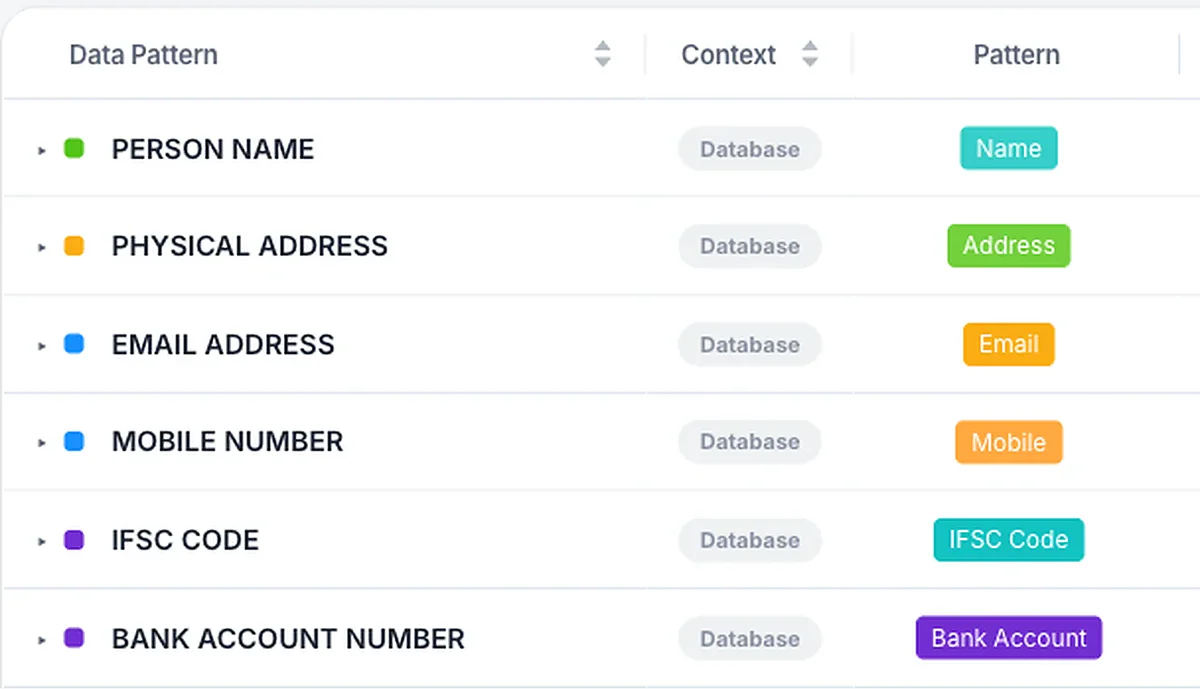
Search covers personal-data locations confirmed in connected databases. It looks up the person by email address, mobile number or PAN.
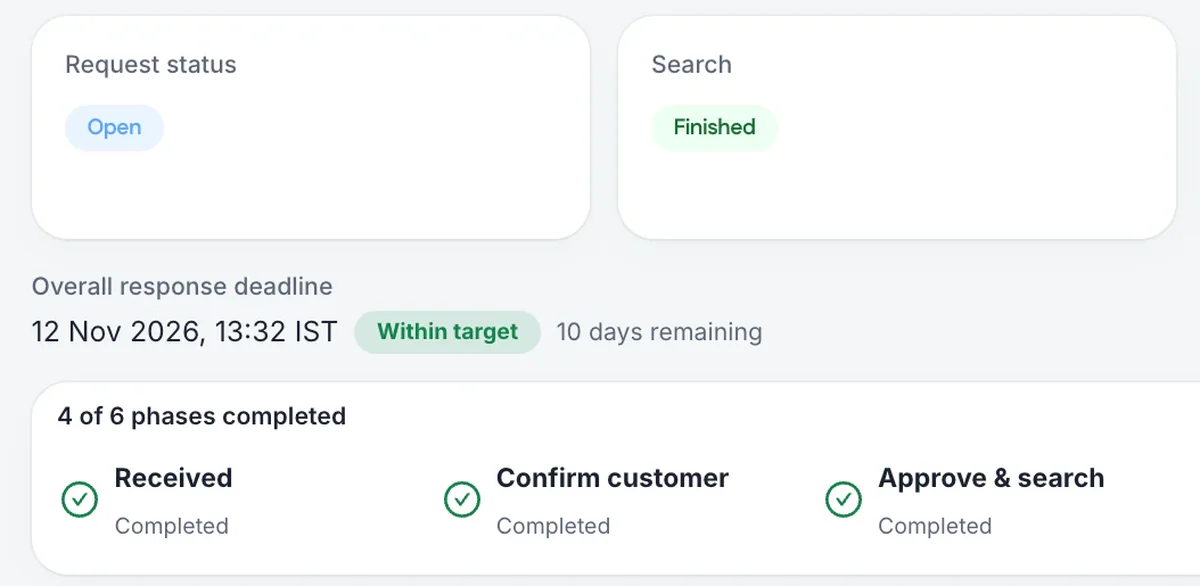
Each request has a deadline clock on your business calendar, so the requests coming due show first.
Each request keeps its search record, its history and every version of the response.
Search covers only locations your stewards have confirmed, and a request moves forward only after the approvals you set.
The purpose registry links each purpose to its data columns, and IRIS flags data with no linked purpose.
The purpose registry records each processing purpose with its legal basis, retention period and status, and links it to the data columns it covers. Your DPO fills the legal-basis list in your organization’s own terms.
IRIS then flags data with no linked purpose, and purposes past their retention period, so your privacy team can review the gaps. Consent records stay in the systems that collected them.
To see where DSAR search fits among the steps of a scan, follow one on the how-it-works page.
Keep request records alongside the evidence register and framework reports.
Confirmed catalog locations are where DSAR search starts.
How privacy teams use IRIS to know what they hold, where and why.
No. Your team makes the change in the source system. IRIS logs the request, tracks it to closure and keeps the record.
No. DSAR search covers connected databases today, and the search record lists file sources as not searched.
IRIS records how identity was verified, as part of the request record. It doesn’t send SMS messages or one-time codes.
Yes. The location is excluded from the request with the reason recorded, as in the loans row above, and the hold is noted on the request.
No. IRIS doesn’t collect, store or check consent records, and it doesn’t connect to consent management platforms. Its purpose registry records why data is used and the legal basis your team assigns.
Many privacy laws do, including GDPR, UK GDPR, CCPA/CPRA, India’s DPDP Act, UAE PDPL and Saudi PDPL. IRIS maps its evidence to UK GDPR and both PDPL controls through its unified compliance framework; a scored readiness view isn’t in v1. Explore compliance
Bring your last three requests. We’ll show you what their record would look like in IRIS.